

Looking for meaningful ways to spark your child’s curiosity without buying expensive kits? This guide to stem projects for kids at home gives you simple, hands-on activities using everyday household items. If you’ve ever wanted to support your child’s learning but weren’t sure where to begin, you’re in the right place. Each activity is carefully selected based on proven child development principles to strengthen critical thinking and problem-solving skills while keeping learning fun. Consider this your practical playbook for turning ordinary moments at home into exciting science, technology, engineering, and math adventures your child will love.
Why At-Home STEM is a Game-Changer for Development
STEM isn’t just a school subject—it’s a mindset. Beyond worksheets and grades, it’s about asking questions, testing ideas, and exploring how the world works. Back in 2020, when many families shifted to learning at home, parents saw firsthand how science experiments in the kitchen or simple engineering challenges at the table sparked deeper curiosity than textbooks alone.
More importantly, these moments build core skills. When a baking soda volcano flops (and it will), kids practice resilience. When they redesign a paper bridge, they tap into creativity. When they notice that more weight changes the outcome, they’re learning cause and effect—basic logic in action.
And then there’s play. Research from the American Academy of Pediatrics shows hands-on play strengthens cognitive development (2018). So instead of feeling like homework, stem projects for kids at home become adventures.
Meanwhile, parents gain something too: connection. Working side by side creates shared wins, shared messes, and lasting memories. For more ideas, explore top free educational websites for kids 2026.
Activities for Little Explorers (Ages 3–5)
Young children don’t need complicated lesson plans. In fact, the trend toward overly structured preschool “academics” often backfires (yes, even those pricey workbooks). What they really need is hands-on discovery that feels like play.
Activity 1: Sink or Float Discovery Bin
Fill a tub with water and gather objects like sponges, toy cars, crayons, and leaves. Before dropping each item in, ask your child to predict what will happen. Prediction means making a thoughtful guess based on what they notice.
This introduces density (how tightly packed something is) and buoyancy (an object’s ability to float). Contrary to popular belief, kids don’t need formal science vocabulary drills to “get ahead.” They need moments of curiosity—like realizing a heavy-looking sponge can float.
• Ask: “Why do you think that happened?”
• Let them test the same object twice (repetition builds understanding).
Activity 2: Marshmallows and Toothpicks
Build squares, triangles, and simple 3D shapes. You’re sneaking in early engineering and geometry while strengthening fine motor skills.
Some argue STEM should wait until elementary school. I disagree. Simple stem projects for kids at home lay groundwork for spatial reasoning early (and they’re far more memorable than flashcards).
Activity 3: Color-Mixing Volcanoes
Combine baking soda, vinegar, and food coloring in cups. This bubbly reaction demonstrates a basic chemical reaction—when substances mix to form something new.
It’s messy. It’s exciting. And it proves learning at this age should feel a little like magic.
Challenges for Young Innovators (Ages 6–8)
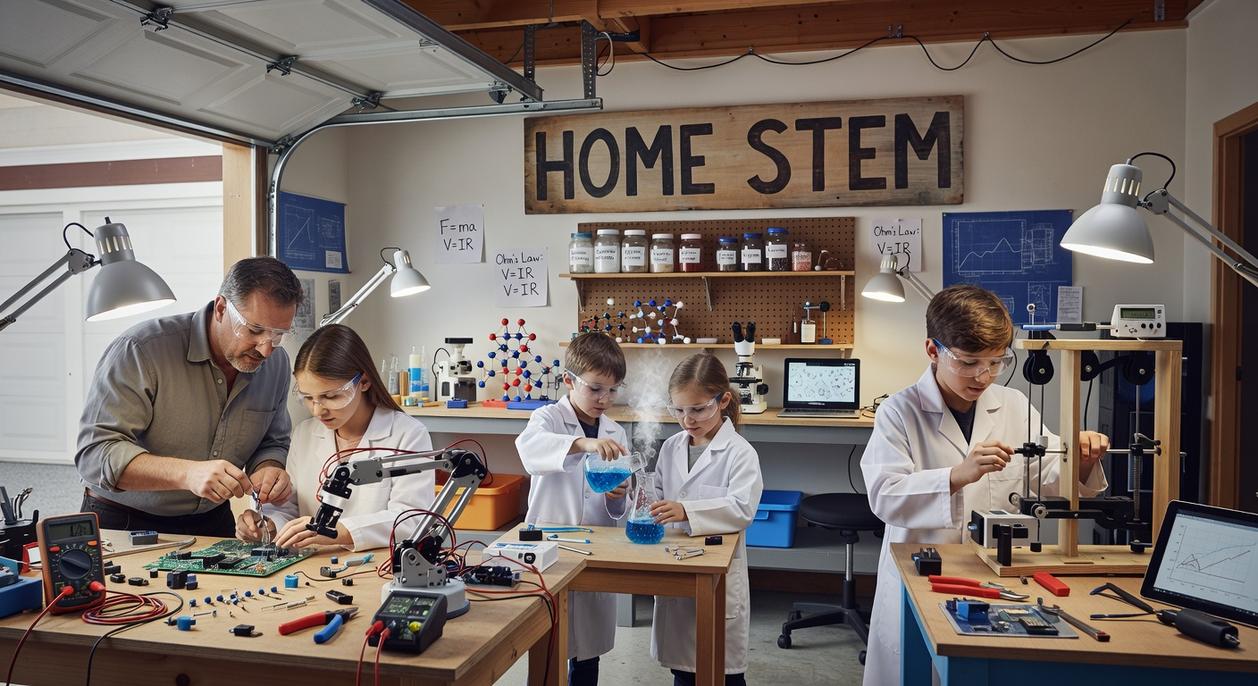
At ages 6–8, kids are naturally curious—constantly asking “why?” and “what if?” These simple engineering challenges channel that curiosity into hands-on discovery. Even better, they double as engaging stem projects for kids at home.
Activity 1: The Unpoppable Balloon
Carefully push a skewer through the thickest parts of an inflated balloon (near the tied end and the top). Because the latex there is less stretched, the balloon often won’t pop. Latex is a polymer, meaning it’s made of long, stretchy molecules. When pressure is distributed evenly, it’s less likely to tear (science magic—but not really).
Learning goal: Understand pressure distribution and material strength.
Activity 2: Build a Paper Airplane Launcher
Using a cardboard tube and rubber bands, create a simple launcher. When stretched, rubber bands store potential energy (stored energy). Once released, that energy turns into kinetic energy (energy of motion), sending the plane flying.
Learning goal: Explore aerodynamics and trajectory. Test different angles to see what flies farthest.
Activity 3: DIY Catapult Challenge
Stack popsicle sticks, secure with rubber bands, and attach a bottle cap to launch soft objects. This demonstrates a lever—a rigid bar that pivots to move weight.
Learning goal: Measure distances and record results to practice systematic testing.
Pro tip: Encourage kids to change only one variable at a time. That’s how real engineers solve problems (and avoid total marshmallow chaos).
Advanced Projects for Future Engineers (Ages 9–12)
Kids this age are ready for bigger challenges—they want to build things that actually work. These projects encourage deeper problem-solving, data tracking, and creative design (and yes, a little trial and error).
Activity 1: Construct a Solar Oven
Using a pizza box, plastic wrap, aluminum foil, and black paper, kids can trap sunlight to heat food. The foil reflects light inward, black paper absorbs heat, and plastic wrap acts as insulation. This demonstrates the greenhouse effect—when heat gets trapped inside a space by a transparent barrier. Encourage kids to measure temperature changes every 10 minutes and record results. (S’mores make great test subjects.)
Activity 2: Code a Simple Game with Scratch
Scratch is a free MIT platform that teaches programming through drag-and-drop blocks. Kids learn sequencing (putting instructions in order) and loops (repeating actions automatically). Pro tip: Have them storyboard their game first to strengthen planning skills.
Activity 3: Build a Simple Electric Motor
With a battery, copper wire, and magnet, children can see how electricity creates motion through electromagnetism—the interaction between electric currents and magnetic fields.
These stem projects for kids at home build confidence, curiosity, and real-world engineering thinking.
Start Your Family’s STEM Adventure Today
You came looking for simple, meaningful ways to keep your child engaged and learning—and now you have a toolbox full of age-appropriate ideas to make it happen. No more scrolling for hours or feeling stuck when boredom hits. The real challenge was never a lack of resources, but seeing the learning potential in everyday items around you.
These stem projects for kids at home prove that curiosity doesn’t require a lab or a big budget—just a little intention and creativity.
Pick one activity your child is excited about, gather a few household materials, and set aside one focused hour this week. Thousands of families trust our expert-backed resources to make learning fun and stress-free—start today and turn ordinary moments into powerful discoveries.
 There is a specific skill involved in explaining something clearly — one that is completely separate from actually knowing the subject. Lauranete Riverans has both. They has spent years working with healthy parenting practices in a hands-on capacity, and an equal amount of time figuring out how to translate that experience into writing that people with different backgrounds can actually absorb and use.
Lauranete tends to approach complex subjects — Healthy Parenting Practices, Educational Resources for Kids, Expert Advice being good examples — by starting with what the reader already knows, then building outward from there rather than dropping them in the deep end. It sounds like a small thing. In practice it makes a significant difference in whether someone finishes the article or abandons it halfway through. They is also good at knowing when to stop — a surprisingly underrated skill. Some writers bury useful information under so many caveats and qualifications that the point disappears. Lauranete knows where the point is and gets there without too many detours.
The practical effect of all this is that people who read Lauranete's work tend to come away actually capable of doing something with it. Not just vaguely informed — actually capable. For a writer working in healthy parenting practices, that is probably the best possible outcome, and it's the standard Lauranete holds they's own work to.
There is a specific skill involved in explaining something clearly — one that is completely separate from actually knowing the subject. Lauranete Riverans has both. They has spent years working with healthy parenting practices in a hands-on capacity, and an equal amount of time figuring out how to translate that experience into writing that people with different backgrounds can actually absorb and use.
Lauranete tends to approach complex subjects — Healthy Parenting Practices, Educational Resources for Kids, Expert Advice being good examples — by starting with what the reader already knows, then building outward from there rather than dropping them in the deep end. It sounds like a small thing. In practice it makes a significant difference in whether someone finishes the article or abandons it halfway through. They is also good at knowing when to stop — a surprisingly underrated skill. Some writers bury useful information under so many caveats and qualifications that the point disappears. Lauranete knows where the point is and gets there without too many detours.
The practical effect of all this is that people who read Lauranete's work tend to come away actually capable of doing something with it. Not just vaguely informed — actually capable. For a writer working in healthy parenting practices, that is probably the best possible outcome, and it's the standard Lauranete holds they's own work to.