

If you’re searching for practical ways to create structure at home, you’re likely looking for realistic, easy-to-follow strategies that make kids daily routines smoother and more effective. Consistent routines help children feel secure, improve behavior, support emotional regulation, and even boost academic success—but knowing where to start can feel overwhelming.
This article is designed to give you clear, research-informed guidance on building routines that actually work for your family. We draw on established child development principles and evidence-based parenting practices to ensure the advice is both practical and grounded in expert insight.
You’ll discover how to create morning, after-school, and bedtime routines that reduce stress, encourage independence, and support healthy development. Whether you’re parenting a toddler or a school-aged child, this guide will help you build structure that fits your family’s needs and sets your child up for daily success.
The Blueprint for a Calm and Connected Family Life
Chaotic mornings versus calm ones often come down to one choice: intention or improvisation. In the first scenario, everyone searches for shoes while tensions rise; in the second, a checklist guides each step. Likewise, stressful afternoons happen when expectations are unclear, whereas predictable transitions help children shift gears smoothly.
This guide breaks down kids daily routines into manageable steps grounded in child development principles. As a result, children know what comes next, which builds security and cooperation. Instead of bedtime battles, you create cues, fostering independence and a happier, connected home.
Why a Predictable Day is a Superpower for Child Development
At first glance, routines can seem boring. After all, who wants every day to look the same? Yet for children, predictability is powerful. When a child knows what comes next, their brain can relax. There’s less guessing, less worrying, and more room for learning. Psychologists link consistent structure to lower anxiety and improved emotional regulation in children (American Academy of Pediatrics).
In addition, routines quietly build independence. When breakfast is always followed by brushing teeth, children begin to act without repeated reminders. They internalize the pattern. Over time, “kids daily routines” become mental scripts they can follow on their own (which feels like magic the first time it happens).
That said, I’ll admit there’s debate about how structured a day should be. Some experts argue too much rigidity can stifle creativity. And honestly, there isn’t a perfect formula for every family. Still, predictable anchors—like regular meals and bedtimes—support healthy sleep cycles and steadier moods, according to the CDC.
Perhaps most importantly, routines reduce power struggles. The schedule becomes the “boss.” Instead of constant negotiations, it’s simply, “This is what we do next.” And sometimes, that small shift changes everything.
The Four Pillars of a Successful Daily Routine
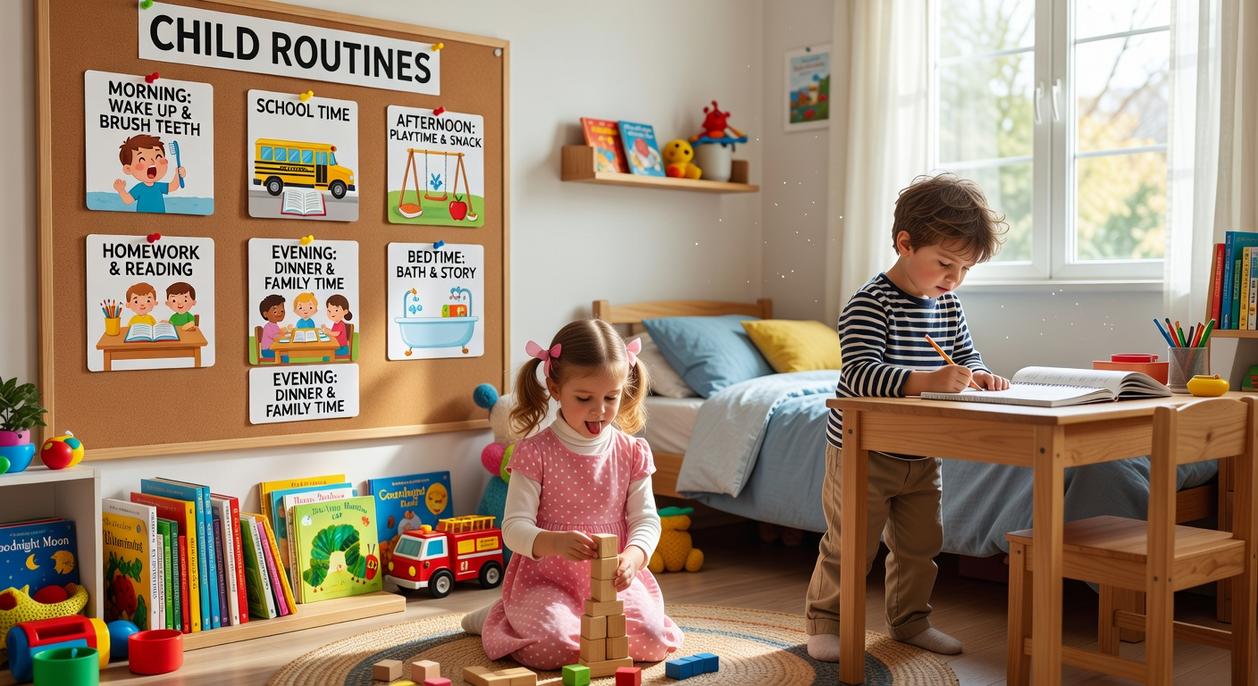
Instead of micromanaging every minute (which usually backfires by Wednesday), focus on four dependable anchor points. These pillars create structure without rigidity—giving children predictability while leaving room for real life.
The Morning Launch
A strong start shapes the entire day. The Morning Launch is a simple, repeatable sequence: wake up, get dressed, eat breakfast, brush teeth. That’s it. No complicated charts required. Research shows that consistent morning routines improve mood regulation and school readiness in young children (American Academy of Pediatrics). Laying out clothes the night before and keeping breakfast options consistent reduces decision fatigue—a term psychologists use to describe the mental drain caused by too many choices. The benefit? Calmer mornings and fewer “Where are my shoes?” moments.
The Midday Anchor
Energy dips are biological, not behavioral flaws. The Midday Anchor builds in intentional recovery time. For younger kids, that may mean a 60–90 minute nap. For older children, designate 30–45 minutes of quiet time with books, puzzles, or drawing, followed by a balanced lunch with protein and fiber for sustained energy (CDC nutrition guidelines). This isn’t laziness—it’s neurological maintenance. Rest improves memory consolidation and emotional control. A predictable pause also makes afternoons smoother and reduces overtired meltdowns.
The Afternoon Wind-Down
Transitions can be tricky. The Afternoon Wind-Down bridges school or daycare and home life with three features: a healthy snack, 20–30 minutes for homework or reading, and at least 30 minutes of free play. Free play supports executive function—skills like planning and problem-solving (Harvard Center on the Developing Child). Think of it as decompression time (even superheroes need a reset between missions). This anchor keeps kids daily routines balanced and prevents pre-dinner chaos.
The Bedtime Power-Down
The most critical pillar is the Bedtime Power-Down: bath, pajamas, brush teeth, read a story, lights out. Consistency trains the brain to associate these cues with sleep, supporting melatonin release (Sleep Foundation). Keep lighting dim and screens off 60 minutes before bed. A stable bedtime routine improves sleep duration and behavior the next day. For stronger connections during this time, explore how to improve parent child communication at any age. A calm ending sets up a confident tomorrow.
Your Action Plan: How to Build and Implement a Routine That Works
Building routines doesn’t have to feel like boot camp. In fact, the best kids daily routines are collaborative, visual, and flexible. So, what’s next after deciding you need more structure? Here’s how to begin:
-
Team Up with Your Child
First, invite your child into the process. For kids over three, offer simple choices: “Pajamas before or after we read?” Choices create ownership, and ownership boosts cooperation (it’s basic psychology: people support what they help create). -
Make It Visual
Next, swap lectures for visuals. Young children think concretely, meaning they understand pictures better than abstract instructions. A simple chart with drawings for bath, book, bed helps them track progress independently. -
Start Small and Build Momentum
Rather than overhauling the entire day, master bedtime first. Sleep routines regulate mood and attention, according to the American Academy of Pediatrics. Once that’s smooth, layer in mornings. -
Be Consistent—But Not a Robot
Finally, aim for predictability, not perfection. If soccer practice runs late, reset at the next anchor point. Progress beats rigidity every time.
And if your child resists? That’s normal. Adjust, observe, and refine. Routines evolve as kids grow.
Navigating Common Roadblocks and Challenges
Handling resistance starts with empathy. When a child pushes back, acknowledge the feeling and restate the limit: “I know you want to play more, and it’s hard to stop. It’s time for our bath now.” Some argue flexibility prevents conflict, but consistent boundaries build security, according to the American Academy of Pediatrics.
As children grow, revisit kids daily routines every few months. Gradually add responsibility—like packing backpacks—so independence develops.
During weekends, holidays, or sick days, keep anchor points such as meals and bedtime steady. Pro tip: preview changes in advance to reduce anxiety.
Peaceful days and restful nights rarely happen by accident. Instead, they grow from small, repeatable patterns your child can trust. When you reduce daily guesswork, power struggles often soften—though I’ll admit, no routine works like magic every time. Research shows predictable structure supports emotional regulation in children, which builds cooperation over time (American Academy of Pediatrics). Still, every family is different, and what clicks for one may need tweaking for another. That’s okay. Start with kids daily routines by choosing bedtime and creating a simple three-step visual plan tonight. Think brush, book, bed—yes, it’s boring, but boring is predictable.
Build Stronger kids daily routines Starting Today
You came here looking for practical ways to create structure, reduce daily stress, and help your child thrive—and now you have the tools to make it happen. From setting consistent wake-up times to creating calming bedtime rituals, you understand how powerful simple, predictable habits can be.
Without clear routines, mornings feel chaotic, homework turns into battles, and bedtime becomes exhausting. That daily frustration adds up—for both you and your child. But with thoughtful, consistent kids daily routines, you create stability, boost confidence, and support healthy development in ways that truly last.
Now it’s time to take action. Start small. Choose one part of your day—morning, after school, or bedtime—and implement a consistent routine this week. Stay consistent, adjust as needed, and watch the difference unfold.
If you want step-by-step parenting strategies, expert-backed guidance, and practical tools trusted by thousands of families, explore more of our resources today. Don’t let another stressful day pass—start building calmer, happier routines now.
 There is a specific skill involved in explaining something clearly — one that is completely separate from actually knowing the subject. Lauranete Riverans has both. They has spent years working with healthy parenting practices in a hands-on capacity, and an equal amount of time figuring out how to translate that experience into writing that people with different backgrounds can actually absorb and use.
Lauranete tends to approach complex subjects — Healthy Parenting Practices, Educational Resources for Kids, Expert Advice being good examples — by starting with what the reader already knows, then building outward from there rather than dropping them in the deep end. It sounds like a small thing. In practice it makes a significant difference in whether someone finishes the article or abandons it halfway through. They is also good at knowing when to stop — a surprisingly underrated skill. Some writers bury useful information under so many caveats and qualifications that the point disappears. Lauranete knows where the point is and gets there without too many detours.
The practical effect of all this is that people who read Lauranete's work tend to come away actually capable of doing something with it. Not just vaguely informed — actually capable. For a writer working in healthy parenting practices, that is probably the best possible outcome, and it's the standard Lauranete holds they's own work to.
There is a specific skill involved in explaining something clearly — one that is completely separate from actually knowing the subject. Lauranete Riverans has both. They has spent years working with healthy parenting practices in a hands-on capacity, and an equal amount of time figuring out how to translate that experience into writing that people with different backgrounds can actually absorb and use.
Lauranete tends to approach complex subjects — Healthy Parenting Practices, Educational Resources for Kids, Expert Advice being good examples — by starting with what the reader already knows, then building outward from there rather than dropping them in the deep end. It sounds like a small thing. In practice it makes a significant difference in whether someone finishes the article or abandons it halfway through. They is also good at knowing when to stop — a surprisingly underrated skill. Some writers bury useful information under so many caveats and qualifications that the point disappears. Lauranete knows where the point is and gets there without too many detours.
The practical effect of all this is that people who read Lauranete's work tend to come away actually capable of doing something with it. Not just vaguely informed — actually capable. For a writer working in healthy parenting practices, that is probably the best possible outcome, and it's the standard Lauranete holds they's own work to.